2026 Tang Prize in Rule of Law Announced
Bruce Ackerman Honored for His Intellectual Leadership in Advancing Contemporary Democratic Constitutionalism and the Rule of Law
TAIPEI, June 18, 2026 /PRNewswire/ -- The 2026 Tang Prize in Rule of Law has been awarded to Professor Bruce Ackerman, Sterling Professor of Law and Political Science at Yale University, in recognition of "his intellectual leadership in developing new conceptions of constitution-making, judicial review, and the structures needed for democratic constitutional governance, offering conceptual and practical approaches to defend the rule of law amid the crises facing modern republics. His comparative engagements and passionate commitment to understanding constitutional legitimacy and popular sovereignty, exercised across generations, have inspired constitutional lawyers around the world in their pursuit of social justice and the rule of law."
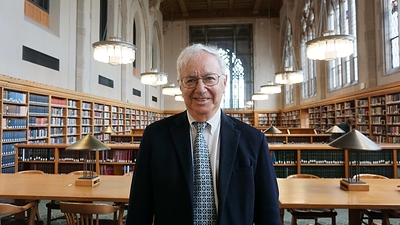
Professor Ackerman's contributions to the rule of law center on his groundbreaking theory of "dualist democracy," which distinguishes between "ordinary politics" and "constitutional politics." Under "constitutional politics," when citizen mobilization reaches its peak, forming a decisive consensus that is later institutionalized into the constitutional order through constitutional mechanisms, it gives rise to a "constitutional moment." This theory provides an essential analytical perspective for the current challenges facing both the constitutional order of the United States (U.S.) and contemporary democracies.
Professor Ackerman's intellectual reach is also deeply grounded in the realm of social justice. He views all citizens as "stakeholders" in society, arguing that the state must address the material inequalities that prevent citizens from becoming full political actors, and ensuring that all citizens possess sufficient economic resources to take part in the public reason process, thereby enabling effective democratic participation.
Professor Ackerman's efforts to bridge theoretical breakthroughs with real-world institutional solutions have been so substantial that their impacts are extensive. His book The Stakeholder Society (with Anne Alstott) has inspired relevant policy initiatives in countries such as the United Kingdom and Brazil; Deliberation Day (with James S. Fishkin) has inspired deliberation initiatives and mechanisms in the U.S. and other countries such as Mongolia; another of his works, Before the Next Attack, likewise inspired the relevant reform of emergency powers in the French constitution.
As a thinker, legal scholar, and educator, Professor Ackerman's thoughts continue to inspire generations of constitutional lawyers around the globe, guiding all toward a more inclusive, resilient vision of rule of law in an era interwoven with crises.
About the Tang Prize
Since the advent of globalization, humanity has enjoyed unprecedented benefits from advances in civilization and science. Yet a multitude of challenges, such as climate change, the emergence of new infectious diseases, the widening wealth gap, and moral degradation, have surfaced along the way. Against this backdrop, Dr. Samuel Yin established the Tang Prize in December 2012. It consists of four award categories: Sustainable Development, Biopharmaceutical Science, Sinology, and Rule of Law. Every two years, four independent and professional selection committees, comprising many internationally renowned experts, scholars, and Nobel laureates, choose Tang Prize laureates who have made substantive contributions and generated a far-reaching impact on the world, regardless of race, nationality, gender, or religion. A cash prize of NT$50 million (approximately US$1.6 million) is allocated to each category, with NT$10 million (approximately US$320,000) of it being a grant intended for research or educational outreach programs to encourage professionals in every field to examine mankind's most urgent needs in the 21st century, and become leading forces in the sustainable development of human society through their outstanding research outcomes and active civic engagement.
 View original content to download multimedia:https://www.prnewswire.co.uk/news-releases/2026-tang-prize-in-rule-of-law-announced-302804241.html