DEEPX and Sixfab Launch 'DEEPX AI HAT' to Drive Edge Physical AI on Raspberry Pi
- Partnership delivers high-performance, low-power AI acceleration directly to the global Raspberry Pi ecosystem
- Eliminates cloud dependency for real-time inference in robotics and smart automation
- Rolls out production-ready Starter Kit and SDKs to lower entry barriers for global developers
SEOUL, South Korea, June 26, 2026 /PRNewswire/ -- DEEPX, an on-device AI semiconductor pioneer, today announced that its ultra-low-power NPU technology is powering the Sixfab AI HAT+ for Raspberry Pi 5, a new edge AI acceleration board developed by Sixfab, an edge AI hardware solutions company and Official Raspberry Pi Design Partner.
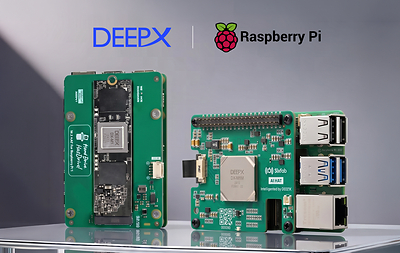
Marked as "Intelligentized by DEEPX," the product brings high-performance, low-power AI inference capabilities to the Raspberry Pi 5 ecosystem, enabling developers and enterprises to build real-time Physical AI applications at the edge.
'The DEEPX AI HAT' integrates DEEPX's proprietary NPU technology to run complex embedded AI models locally and in real time. It delivers an optimized balance of computational power and energy efficiency, enabling robust Physical AI inference in power-constrained environments such as robotics, smart agriculture, and factory automation.
"The DEEPX AI HAT offers our global community of enterprise developers and makers a highly efficient path to scale edge AI applications," said Roger Thornton, Director of Applications at Raspberry Pi.
To accelerate commercial adoption, DEEPX is rolling out a comprehensive developer package globally:
- Developer-Friendly SDKs: Software tools optimized for seamless model compilation and instant edge deployment.
"The future of Physical AI does not reside within a handful of data centers; it belongs to the billions of devices, robots, and industrial endpoints in the real world," said Lokwon Kim, CEO of DEEPX.
"By pairing Raspberry Pi's versatility with our low-power NPU, we aim to drive the democratization of Physical AI so that anyone can build and deploy advanced AI solutions." Kim added, "This launch is a cornerstone of our long-term strategy to cultivate future talent and developer ecosystems. DEEPX will expand collaborations with governments, academia, and industries worldwide to ultimately emerge as the definitive global standard platform for Physical AI."
The DEEPX AI HAT will soon be available worldwide through authorized distribution channels. Moving forward, DEEPX and Raspberry Pi anticipate further technical cooperation to elevate the platform as an enterprise-grade AI edge node.
Official Channel
Homepage: https://deepx.ai/
LinkedIn: https://www.linkedin.com/company/deepx-corp/
Youtube: https://www.youtube.com/@deepx2692/

 View original content to download multimedia:https://www.prnewswire.co.uk/news-releases/deepx-and-sixfab-launch-deepx-ai-hat-to-drive-edge-physical-ai-on-raspberry-pi-302811628.html