From 800kW Distributed Systems to PV-ESS Integration: Kehua Showcases Next-Gen Charging Innovation at Power2Drive Europe 2026
MUNICH, June 25, 2026 /PRNewswire/ -- Shenzhen Kehua, a reliable EV charging equipment provider and a subsidiary of Kehua Group, showcased its full turnkey EV charging solutions at Power2Drive Europe 2026, highlighting innovations in high-power, high-reliability, and intelligent charging infrastructure.
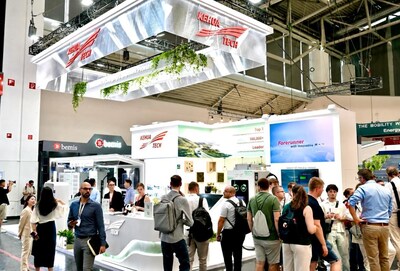
The company presented a comprehensive portfolio, including an 800kW distributed charging system, standalone DC chargers (60–180kW and 240–400kW), high-reliability charging modules (40kW SiC CE/UL power module, 40kW liquid-cooling power module, and 80kW VPFC power module), and an integrated PV-ESS-Charging solution. All solutions are designed to deliver a more reliable, efficient, and intelligent charging experience for global CPOs.
The 800kW distributed charging system is a key highlight. CE and CB certified, it features an 800kW power unit supporting dual-cabinet expansion up to 1.6MW. It is compatible with 500A air-cooled, 600A liquid-cooled, and MCS dispensers, with an output current range of 250A–1500A. It supports passenger vehicles, commercial fleets, electric trucks, electric aircraft, and other high-power charging scenarios, enabling scalable fast-charging infrastructure deployment.
In terms of performance, the system achieves 96.5% peak efficiency, maintains full power output up to 50°C, and is engineered with IP55 & C4-H protection for harsh environments. A multi-layer safety architecture with 100+ protections, automotive-grade manufacturing, and in-position module detection ensures operational safety and reliability. Optimized airflow design also reduces noise for improved user experience.
Kehua also introduces scenario-based intelligent charging strategies. During daytime hours, based on real-time vehicle demand, the system dynamically switches between power optimization mode, efficiency optimization mode, and charging module lifetime balancing, improving operational efficiency, system stability, and overall revenue performance. At night, it shifts to centralized balanced charging to optimize power distribution.
The CE and CB certified standalone DC charger portfolio covers both passenger and commercial vehicles, with power ranges from 60–180kW and 240–400kW. Designed for global deployment, the chargers operate reliably in extreme conditions such as high heat, cold, rain, dust, and salt fog. With IP55 protection and an operating temperature range of -30°C to 55°C (no derating at 50°C), they are optimized for markets including the Middle East, Southeast Asia, and Europe, while ensuring high efficiency, low noise, and easy maintenance.
With 38 years of expertise in power electronics and a team of over 1,000 R&D engineers, Kehua delivers end-to-end EV charging solutions, including DC charging modules, ultra-fast chargers, megawatt charging systems, and integrated PV-ESS-Charging solutions.
Photo - https://mma.prnewswire.com/media/3000394/image1.jpg
 View original content:https://www.prnewswire.co.uk/news-releases/from-800kw-distributed-systems-to-pv-ess-integration-kehua-showcases-next-gen-charging-innovation-at-power2drive-europe-2026-302810652.html