Sungrow Launches SG510HX & MVS Turnkey Solution for Enhanced Utility-Scale PV Lifecycle Value
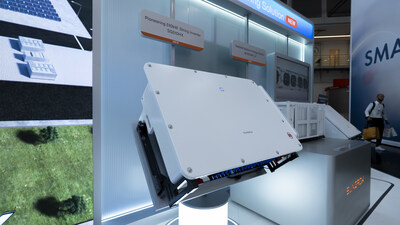
MUNICH, June 25, 2026 /PRNewswire/ -- Sungrow, the globally leading PV inverter and energy storage system (ESS) provider, unveiled the SG510HX & MVS Turnkey Solution at Intersolar Europe 2026. The solution integrates the SG510HX string inverter and the MVS7440-LV medium-voltage station in a native system architecture, reducing LCOE by up to 1% while delivering advanced safety and grid-forming capabilities, and ultimately enhancing lifecycle value for utility-scale PV plants.
Maximizing Lifecycle Value and Project Economics
- The SG510HX inverter delivers a maximum output of 511.5 kW and achieves a 28% increase in power density, enabled by next-generation SiC devices, third-generation cooling technology, and high-performance magnetic materials. In parallel, AI-driven power optimization enhances active power delivery under grid-support scenarios, helping increase overall energy yield and project returns.
- Reducing BOS costs by up to USD 180,000 per 100 MW project, the solution minimizes investment in mounting structures, cables, and balance-of-system equipment by combining a long-string design, a 7.44 MW+ large-block architecture, and a 1000 V AC system.
- Delivering COD 15 days earlier for a typical 100 MW project, off-grid commissioning enables full system verification using PV power and eliminates the need for diesel generators. The MVS7440-LV is also delivered pre-installed and pre-commissioned, further reducing on-site integration effort.
From Device-Level Protection to System-Level Safety
The solution is built on a multi-layer safety and protection architecture designed to ensure reliable operation under all operating and environmental conditions.
- Triple-layer Redundant DC Protection. The SG510HX inverter is equipped with Smart Shutdown Solution 3.0. Built on a mechanical switch and an electronic backup switching architecture, it rapidly interrupts fault current under extreme conditions, reducing backfeed risk. Primary and secondary intelligent trip switches ensure automatic disconnection during fault incidents. A Smart Lockout mechanism further enhances safety by ensuring reliable fault isolation and preventing unintended re-energization before faults are cleared.
- All-Condition Lightning Protection Across the Entire Lifecycle. Unlike conventional designs focused mainly on standby states, Sungrow's approach extends protection across the entire project lifecycle, including construction, standby, and grid-connected operation, validated through CGC certification testing.
In addition, this solution enables bidirectional communication and coordinated protection during insulation faults or temperature anomalies, allowing real-time information sharing and system-level response to enhance overall safety. In contrast, conventional standalone architectures rely on independent device-level responses, which may result in delayed or uncoordinated protection and a higher risk of fault escalation.
Grid-Forming for Stable Operation Across Grid Conditions
As power systems evolve with higher renewable penetration, grid strength varies widely across regions, requiring technologies that ensure stability under diverse conditions. Powered by Sungrow's grid-forming technology, this solution enhances grid stability through flexible inertia support (<5 ms) to reduce fluctuations, instant reactive power response for stronger voltage support, and millisecond-level damping control across the 0.1–100 Hz range to suppress oscillations and minimize protection-related shutdown risks.
Smart O&M for Simplified Lifecycle Management
The SG510HX & MVS Turnkey Solution streamlines deployment and reduces O&M complexity across the project lifecycle. One-click remote configuration enables fast parameter validation and simplified commissioning, while Smart IV Diagnosis 2.0 allows full-site inspection via a laptop without dedicated servers, lowering operational costs. AI-driven duct cleaning automatically removes dust and blockages through airflow reversal, reducing manual maintenance. Integrated cold-shrink cable termination and a dust- and insect-resistant design further minimize installation and upkeep effort.
The solution reflects the utility-scale solar sector's shift toward improved lifecycle economics and higher operational efficiency, where system-level integration is key to reliable and cost-effective power delivery. Backed by full-stack R&D capabilities, Sungrow continues to advance integrated solutions for global utility-scale PV deployment.
Photo - https://mma.prnewswire.com/media/3000397/510_MVS.jpg
Logo - https://mma.prnewswire.com/media/1344575/Logo.jpg
 View original content:https://www.prnewswire.co.uk/news-releases/sungrow-launches-sg510hx--mvs-turnkey-solution-for-enhanced-utility-scale-pv-lifecycle-value-302810595.html