Taiwan Showcases Integrated Pharma Supply Chain Solutions at CPHI Milan 2026 Amid Global Restructuring
MILAN, Oct. 8, 2026 /PRNewswire/ -- A news report from GeneOnline.
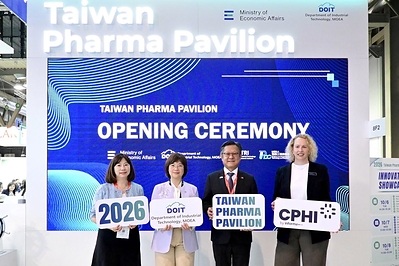
Amid rapid restructuring in the global pharmaceutical supply chain, drugmakers around the world are increasingly prioritizing supply reliability, manufacturing quality and diversified partnerships. To address these evolving industry demands, Taiwan has brought together 22 leading biotech and pharmaceutical companies at CPHI Milan 2026. Supported by Taiwan's Ministry of Economic Affairs (MOEA) and organized by the Industrial Technology Research Institute (ITRI), the Taiwan Pharma Pavilion demonstrates the region's comprehensive capabilities, seamlessly integrating its advanced technology sector with pharmaceutical manufacturing to offer resilient solutions for the global market.
Taiwan has established a strong foundation as a trusted partner in the international pharmaceutical ecosystem. Supported by continuous investments in manufacturing workflows and novel drug development, over 170 pharmaceutical manufacturers in Taiwan currently operate under stringent PIC/S GMP standards. The region exports more than 90% of its active pharmaceutical ingredients (APIs), while finished pharmaceutical products consistently reach highly regulated markets, including Japan and the United States, underscoring its capacity for high-quality, scalable production.
"The global pharmaceutical supply chain is undergoing a strategic realignment," said Dr. Maggie Lu, ITRI's Vice President and General Director of Biomedical Technology and Device Research Laboratories. "Global pharmaceutical companies are looking beyond manufacturing capacity alone. Quality certifications, supply chain resilience, advanced R&D capabilities, and manufacturing flexibility are now the key criteria for selecting strategic partners. Taiwan's strengths in these areas are helping its pharmaceutical industry play a greater role in the global pharmaceutical supply chain."
Rather than competing solely on volume, the Taiwan Pharma Pavilion highlights collaborative opportunities across three core areas:
- AI-Driven Drug Discovery & Preclinical Research: Leveraging Taiwan's profound ICT prowess, participating companies showcase advanced AI platforms and R&D tools designed to accelerate target identification, drug screening, and preclinical validation.
- APIs & CDMO Services: Addressing the industry's need for supply chain diversification, Taiwanese manufacturers offer reliable raw material supply, scalable process development, and flexible contract manufacturing services backed by international certifications.
- Innovative Therapeutics & Advanced Formulations: Taiwan brings cutting-edge capabilities in novel drugs, 505(b)(2) high-barrier generics, and advanced drug delivery technologies, opening doors for co-development, technology licensing, and global market expansion.
Taiwan's engagement at CPHI Milan extends beyond the exhibition floor to the executive level. Demonstrating the region's growing industry influence, Dr. Maggie Lu has been invited to deliver the opening remarks at the prestigious CPHI Leadership Summit. This platform allows Taiwan to engage directly with senior executives from global pharmaceutical leaders such as Boehringer Ingelheim, FUJIFILM, and Lonza, bringing Taiwan's integrated strengths into high-level strategic dialogues on the future of pharma.
From early-stage AI drug discovery to commercial-scale manufacturing, the "Team Taiwan" approach consolidates its comprehensive pharmaceutical value chain. By expanding partnerships in raw material supply, contract manufacturing, co-development, and global licensing, Taiwan is ready to play a pivotal role in the next generation of global healthcare.
 View original content to download multimedia:https://www.prnewswire.co.uk/news-releases/taiwan-showcases-integrated-pharma-supply-chain-solutions-at-cphi-milan-2026-amid-global-restructuring-302902616.html